Güvenpark: Kızılay’s Main Square and the Security Monument
In the heart of Ankara, on Kızılay Square, nestled between government buildings and a stream of buses, lies Güvenpark—a small but one of the most famous city parks in the Turkish capital. Its role is unlike that of typical “green oases”: it is a public space, a transportation hub, and the site of the 1935 Security Monument, which has become one of the symbols of the early Turkish Republic. Every resident and visitor to Ankara passes through Güvenpark at least once—all the main routes through the city center converge here.
History
The park was designed as part of the capital’s first master plan, developed in 1929 by German architect Hermann Jansen. This plan called for the creation of a system of green spaces in the new Ankara to ensure that the rapidly growing capital maintained a healthy climate and public spaces. Güvenpark became one of the key elements of this scheme, covering 2.5 hectares in the very center of the Kızılay district.
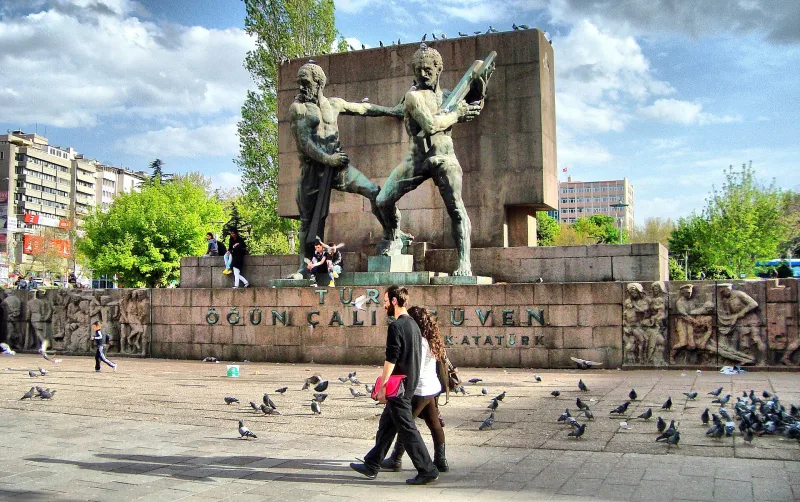
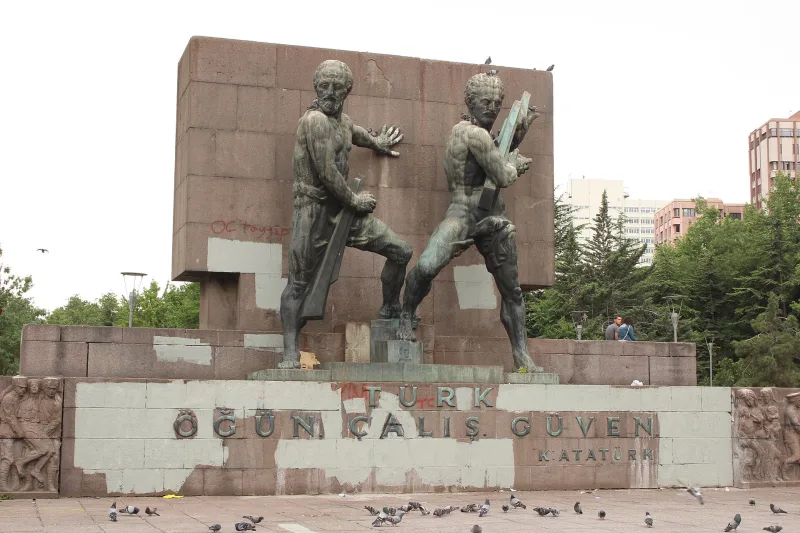
In 1935, the park’s main feature—the “Güvenlik Anıtı” (Security Monument)—was installed. The concept was proposed by Austrian architect Clemens Holzmeister; the sculptural portion was begun by Austrian Anton Hanak, but after his death in 1934, the work was completed by German master Josef Thorak. The bronze figures were cast in Vienna and delivered to Ankara in the early 1930s. The monument is dedicated to the Turkish army, police, and security forces of the young republic, and its reliefs depict peasants, soldiers, artisans, and law enforcement officers.
In the 21st century, Güvenpark has witnessed tragic events. On March 13, 2016, a car bomb driven by a suicide bomber exploded near the park’s bus stops: 37 people were killed, and more than a hundred were injured. The park remains a site of civic remembrance and periodically serves as a venue for public gatherings and protests.
What to See
Güvenlik Anıtı (Security Monument)
The park’s main attraction is a tall monument, unveiled in 1935. Its central stele rises 37 meters, and the bronze figures on either side are about 6 meters tall. The reliefs depict soldiers, police officers, peasants, and workers—a collective image of civil society in the young Turkish Republic. Above the facade is inscribed Atatürk’s famous phrase: “Türk! Öğün, Çalış, Güven”—“Turk, be proud, work, trust.”
Avenues and Fountains
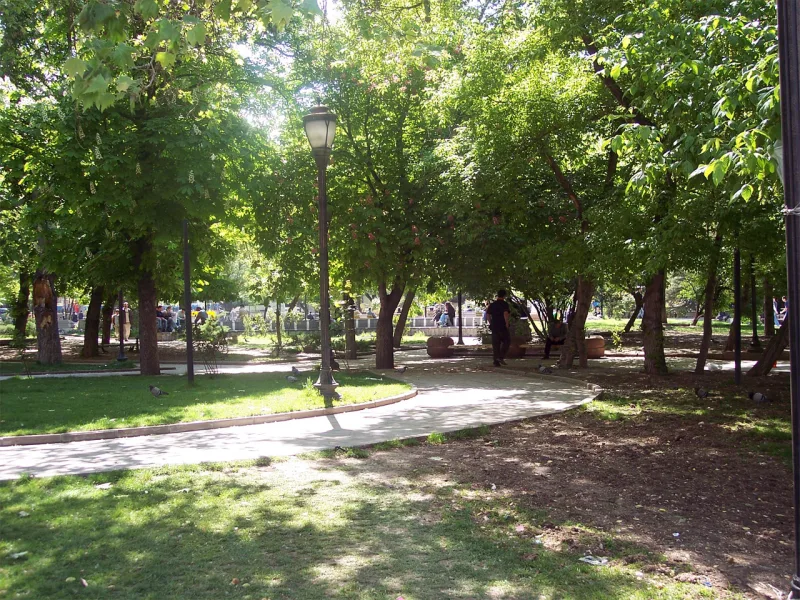
Paved paths run along the perimeter of the park, and there are several small fountains and flower beds. During the warmer months, the park is popular with office workers and students from nearby universities. Large plane trees provide shade and shield the park from the surrounding city noise.
Transportation Hub
The northern and western sides of Güvenpark are home to Ankara’s largest cluster of minibus stops (dolmuş). Minibuses depart from here to all parts of the city and the suburbs—this is a part of urban culture worth observing, if only out of curiosity. The Kızılay Metro Station (Ankaray and M2 lines) is located at the northern edge of the park.
Interesting Facts
- The park covers an area of 2.5 hectares. It was included in Ankara’s first master plan, developed by Hermann Jansen in 1929.
- The 1935 Security Monument was created by Austrian and German artists: Clemens Holzmeister (concept), Anton Hanak (began the sculpture), and Josef Thorak (completed it). The bronze was cast in Vienna.
- Atatürk’s motto, “Türk! Öğün, Çalış, Güven” — “Turk! Be proud, work hard, trust” — is carved on the monument’s pediment and became one of the most frequently quoted slogans of the early republic.
- On March 13, 2016, a major terrorist attack took place at Güvenpark: 37 people were killed. This was the third major attack in Ankara in six months.
- Güvenpark is officially registered by the Çankaya Municipality as a nature conservation area, which has repeatedly been cited as an argument against plans to build an underground parking garage beneath it.
How to get there
Güvenpark is located in the very center of Ankara, in the Kızılay district (Çankaya), at the intersection of Atatürk Bulvarı and Ziya Gökalp Caddesi. GPS coordinates: 39.9195° N, 32.8532° E. The closest metro station is Kızılay (lines M2 and Ankaray)—the exit leads directly to the northern part of the park.
From Esenboğa Airport, take the Havaş bus or a taxi to Kızılay (about 40 minutes without traffic). From Anıtkabir, it’s about a 25-minute walk down Atatürk Boulevard. Parking in Kızılay is difficult and expensive, so the metro is highly recommended. From here, it’s easy to get anywhere in Ankara: Çankaya, Tunalı, Ulus, and the museum district are all within easy reach.
Tips for travelers
The best time for a walk is in the morning or evening, when there is no midday office rush. In summer, the shade of the plane trees offers relief from the heat; in winter, the park looks particularly austere and atmospheric. A full tour of the park and the monument will take 20–30 minutes.
Don’t try to walk through the park with heavy luggage: there’s very heavy traffic around, and the minibus stops are constantly crowded. If you need to take a dolmuş, check the route number in advance—it can be difficult to navigate without knowing Turkish.
Güvenpark is best combined with a walk along Atatürk Bulvarı: to the north of the park, it leads to the old center of Ulus with its ethnographic museum and fortress; to the south, it leads to the Tunalı district with Kuğulu Swan Park and cafes. Güvenpark itself is best viewed not as a picnic spot, but as the heart of Ankara’s urban fabric—with its history, politics, and daily hustle and bustle.